



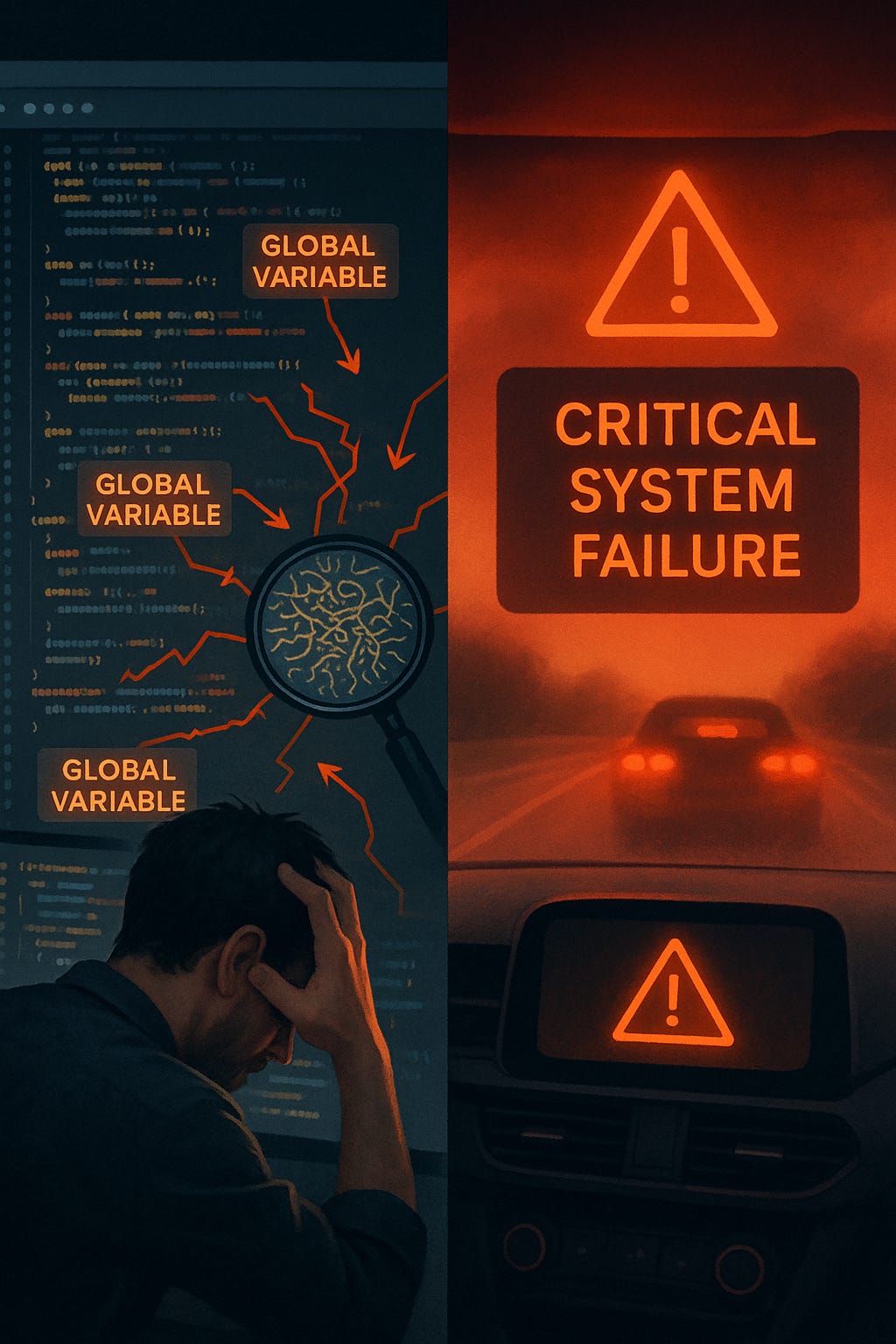
In the high-speed world of automotive software development, where reliability is no longer an option but a matter of life and death, each design choice is of enormous consequence. The employment of global variables is a particularly sly technique, when writing software that meets functional safety standards such as ISO 26262.
Though they may seem to provide convenience – instant access to information from anywhere within the codebase – global variables are actually sneaky saboteurs. They present a myriad of problems that erode maintainability, predictability, and, in the long run, the safety of your automotive systems. Let's unpack why global variables represent a basic anti-pattern in safety-critical automotive software:
The Developer Impact: A Maintenance Labyrinth
Picture a huge, intricate automotive embedded system with thousands of lines of code. Picture attempting to trace out every location where a global variable could be read from or, more importantly, written.
Spaghetti Data Flow:
Global variables introduce latent dependencies. A modification of a global in a corner of the code will have unintended effects in an entirely unrelated module. This spaghetti data makes it virtually impossible to know the system's real behavior without tracing every access.
Decreased Readability:
For a new programmer coming in on the project, learning the system state is an enormous undertaking. They can't just glance at a function signature to learn its inputs and outputs; they have to deduce its interaction with perhaps dozens of global variables.
Refactoring Nightmares:
Modifying or removing a global variable, even if it seems unused, requires an exhaustive analysis of the entire codebase to ensure no hidden dependencies are broken. This makes refactoring risky and time-consuming, often leading developers to avoid necessary architectural improvements.
Unpredictable Memory & Concurrency Issues (Beyond the Stack)
Although global variables do not live on the stack (they live in static memory), they pose critical memory and concurrency issues that are just as, if not more, hazardous in a real-time, multi-threaded automotive environment.
Race Conditions Galore:
Where there is more than one task, thread, or interrupt service routine (ISR) – and this is a typical situation in automotive ECUs
global variables are the first to be targeted by race conditionsIf two or more paths of concurrent execution try to change a global variable without any appropriate synchronization controls (such as mutexes or semaphores), the resultant value of the variable is non-deterministic and relies on the timing of execution. This is a well-known root of hard-to-reproduce bugs.
Memory Footprint & Lifetime:
Global variables hold memory throughout the application's lifetime, whether they are in use or not. Although this may appear insignificant, in resource-limited ECUs, poorly optimized memory usage can cause other problems or constrain future features. More significantly, their eternal presence means that their state is preserved across execution cycles, with the risk of propagating erroneous values from previous operations.
On average, most of the ECU have more than 80% of RAM consumption, its very hard to eliminate global variables.Cache Coherency Issues:
In multi-core processors, global variables shared among multiple cores can cause cache coherency issues, where multiple cores may retain stale versions of the variable within their local caches, creating yet another layer of complexity and potential for misbehavior.
The Catastrophic Effect on Data Flow
Data flow addresses how data is transferred, converted, and utilized across the software system. Global variables devastate this important factor:
Hidden Inputs and Outputs:
Functions manipulating global variables have "hidden inputs" and "hidden outputs." A function's interface may imply that it has no arguments or no return value, but it might be reading from or writing to a global variable, effectively changing its behavior or system state. This renders function contracts transparent.
Inability to Trace Data Origin:
When a bug is created due to a global variable containing an improper value, it is extremely hard to trace back the source of that corruption. Without explicit parameters, there is no direct "chain of custody" for the data. Where does this value originate? Which one of the numerous functions capable of writing to this global actually set it improperly?
Massive Side Effects:
All functions that change a global variable produce a side effect on the overall system state. This violates modularity and prevents reasoning about the behavior of a function in a vacuum, since its effect permeates far beyond its immediate return value or output parameters.
No Single "Owner" of Data:
Without encapsulation, global data does not have a single responsible owner. Anywhere in the code can change it, causing a diffusion of responsibility and turning debugging or updating data structures into a minefield.
The Dangers of the Impact on Control Flow
Control flow governs the sequence in which instructions are followed and decisions are taken within the software. Global variables add perilous unpredictability to control flow:
Hidden State-Dependent Decisions:
Decision points (e.g., `if` statements, `switch` cases) usually rely on the value of variables. If such variables are globals, their values might be changed by any other section of the system at any time. This implies the actual run-time path (control flow) might get changed in an unpredictable manner depending upon the hidden state of global variables, and it is very hard to test all the possible execution paths.
Execution Path Non-Determinism:
As soon as more than one task or ISR have the ability to alter global variables, the exact timing of these alterations matters. The sequence in which these simultaneous operations occur may decide which branch of an `if` statement is executed or which `case` in a `switch` is entered. This results in non-deterministic control flow, where identical inputs will produce different outputs as a function of infinitesimal timing differences – the signature of an untestable and unsafe system.
Complex Cyclomatic Complexity:
Although not technically raising the raw number of decision points, implicit dependencies created through globals raise the effective complexity of comprehending and checking control paths significantly. Any function that accesses a global inherently relies on any function that modifies it, thus building an intertwined web of possible execution paths.
The Exorbitant Cost of Diagnostics
When a system fails as a result of an incorrect state of a global variable, the debugging process is a nightmare.
We Can't Trace Backwards:
Compared to local variables propagated via a call stack, there isn't a traceable chain of custody for a global variable value. You cannot simply look at the call stack and determine from where an incorrect value is coming.
Debugging Hell:
Pinpointing the exact line of code that corrupted a global variable often requires setting breakpoints everywhere it's accessed, meticulous logging, or advanced (and costly) hardware debugging tools. This process is incredibly time-consuming, expensive, and often delays critical project milestones.
Certification Obstacles:
Traceability and debuggability are most important for ISO 26262. Diagnosing systems that are difficult to diagnose extend the verification and validation phases, making development more expensive and potentially holding up certification.
Bug Leakage and Propagation
A small bug that corrupts a global variable in one location of the software can "leak" or propagate its faulty state throughout the whole system.
Far-Reaching Consequences:
A malfunctioning sensor processing function that writes to a global vehicle_speed variable in an erroneous way could, for example, cause mistaken braking decisions, inappropriate cruise control operation, and misleading dashboard display – all apparently disparate functionalities affected by one tainted global.
Hard to Localize Repairs:
If the bug appears in a remote location of the code from where the global was damaged, it is a "whack-a-mole" to fix it. A repair in one place may unexpectedly create problems somewhere else because the interaction between the global and the rest of the system wasn't well understood.
This renders it difficult to obtain "freedom from interference," one of the most important ISO 26262 guidelines.Beyond the Basics: Functional Safety Compliance
The utilization of global variables is in direct contradiction to some of the basic principles of ISO 26262:
Modularity & Independence:
Strong isolation of safety functions is usually needed. Global variables disturb this isolation by introducing implicit coupling among modules, which is difficult to prove their independence.
Interference Freedom:
It becomes extremely difficult to prove that the execution or use of data of one software component does not negatively impact another when globals are present, particularly in relation to shared global state.
Verification & Validation:
It is very challenging to unit test functions that depend on globals, with convoluted test arrangements or heavy mocking often necessary to mimic the external state. Integration testing becomes more cumbersome and less efficient at identifying root causes since the interactions are opaque.
Traceability:
Tracing back requirements to design elements and subsequently to code, particularly data flow and control flow, becomes unclear and excessively complicated with extensive global variable usage.
How Tools Can Assist (But Not Fix)
Although removing global variables is the optimum objective, tools can provide some detection and mitigation:
Static Analysis: These tools examine source code without running it.
Uninitialized Global Detection: Detect global variables that are declared but not initialized prior to their usage.
Reports for Global Variable Usage: Plot where each global variable is read and/or written. This is a visual indicator for following implicit data flow.
Enforcement of Coding Standard (e.g., MISRA C):
MISRA C, popular in the automotive sector, has certain rules (e.g., Rule 8.7, 9.3, 13.5, 17.8) that limit or discourage some applications of global variables, particularly those that are not declared `static` at file scope, and those read by ISRs or multiple tasks. Static analysis tools can automatically report violations, imposing improved data encapsulation.
Possible Race Condition Detection:
Static analyzers with advanced capabilities can analyze control flow and data flow to identify possible race conditions on global variables, even if absence cannot be proven.
Tools : Polyspace, PC-Lint, SonarQube, Helix QAC.Dynamic Analysis: Such tools observe software behavior at runtime.
Runtime Error Detection: Allows for detection of real race conditions, memory corruption, and access to uninitialized global variables at testing time. This validates bugs found with static analysis or reveals new ones that only appear at runtime as a result of particular control flow paths.
Code Coverage: Ensures proper testing of all execution paths, including those that involve global variable changes, which is important for validating complex control flows.
Memory Profiling: Pinpoint memory usage patterns and potential leaks associated with global variables (even less frequent with static memory, but can reflect unforeseen persistent state).
Methods: Special hardware debuggers with tracing, special runtime error detection support libraries, logic analyzers.The Way Forward: Encapsulation and Clean Interfaces
The way out of the global variable problem is to accept encapsulation and clean interfaces.
Pass by Parameter:
Pass data between functions explicitly as parameters. This makes data flow transparent, testable, and deterministic, making function contracts and control flow dependencies clear.
File-Scoped Static Variables:
For information actually unique to a single compilation unit, static file-scope variables (`static int my_var;` in a `.c` file) provide a safer replacement for global variables. They limit visibility, facilitating easier reasoning about their access and data flow localized to regions. But even these need to be carefully handled in order to avoid race conditions in multithreaded systems.
Principles of Object Orientation:
Even in C, using object-oriented thought (structs with corresponding functions) will encapsulate data and the functions that alter it, instead of making raw data available everywhere. This keeps related data and code together that acts upon it, resulting in clean data flow and more predictable code.
Design Patterns:
Use design patterns such as the "Singleton" pattern (judiciously and only when absolutely necessary, since they can reproduce global issues if used too extensively) or "Dependency Injection" to deal with shared resources in a controlled way, with explicit dependencies instead of implicit ones.
When it comes to automotive functional safety, taking shortcuts with global variables is a risky bet. Though they are superficially convenient,
Global variable create systemic hazards that make maintenance worse, complicate data and control flow, cause system behavior to be unpredictable, drive diagnostic costs higher, and make conforming to rigid safety standards such as ISO 26262 far more difficult.Today's automotive software requires strong, predictable, and verifiable code. Through careful avoidance of global variables and embracing of principled design with well-defined interfaces and encapsulation, developers can create safer, more reliable, and ultimately more maintainable systems – so the cars of the future are not only smart, but flawlessly safe.